Script to disable right click

Tuesday, October 28, 2014

Answers to some important questions of class 7 from Water and Wastewater Management


Answers to some important questions of class 7 from Water and Wastewater Management

Chapter: Water

Q 1: Why is groundwater generally pure?

A 1: Groundwater is water found in the spaces between soil particles and cracks in underground rocks.
As groundwater passes through different layers of the soil – humus, top soil and rocks, it gets filtered and thus can be treated as pure or free from general impurities.

Q 2: Heavy rain is good for recharging groundwater. Comment.

A 2: Groundwater recharge is a process where water moves downward from surface water to groundwater. Rains are the natural method to recharge groundwater.

If heavy rain happens only once then it will not recharge groundwater much as water goes through soil slowly (percolation). But, lot of heavy rains over a period of few days can definitely help in passing of water from upper layers to lower portions or rocky layer, a slow process, to store rain water and thus recharge groundwater.

Chapter: Wastewater Management

Q 1: Open drainage system of sewage disposal is health hazard. Explain. Support your answers with suitable examples.

A 1: Open drainage system of sewage disposal is open or uncovered and does not have sanitation which can cause diseases. The less the sanitation, the more the diseases.
Open drainage system of sewage disposal is a health hazard due to following reasons:
- Foul smell causes respiratory diseases and makes it difficult for people to breathe.
-  Refuse and faecal matter in drains quickly becomes bad in smell as it decomposes. It is a suitable medium for flies and mosquitoes for egg-laying and a site for many pathogenic bacteria and viruses to multiply.

Q 2: What is the function of anaerobic and aerobic bacteria in the process of waste water treatment? Explain giving suitable examples.

A 2: In waste water treatment, sludge in the digester tank is allowed to decompose with the help of anaerobic bacteria (bacteria which can survive in the absence of oxygen) to produce biogas, that can be used for the generation of electricity.

Air is pumped into the clarified water or water without solid impurities to help aerobic bacteria to grow. Aerobic bacteria consume human waste, soaps and other unwanted matter still remaining in clarified water.

Wednesday, June 25, 2014

Four Famous Monuments In Delhi


Monument is a building, structure, or site that has historical importance. 

Delhi is an ancient city and has many monuments that serves as a proof of its admirable past. Four famous monuments with brief information about them and their pictures are listed below:

Red Fort or Lal Quila:


  1. The Red Fort is a large monument in Old Delhi with a circumference of 2.2 kms and was gotten built by Mughal Emperor Shah Jahan.
  2. The Red fort was supposed to be the fortress of the Shah Jahan's new capital at Delhi, Shahjahanabad.
  3. It is situated on the banks of Yamuna river and its construction took 10 years, from 1638-1648.
  4. The fort has a Naqqar Khana or the drum room, the Diwan-e- Am or the Hall of public. There is also the Mumtaz Mahal, Khas Mahal, Diwan-e- Khas, Rang Mahal, Khas Mahal, Hammam or the bathing area and Shah Burj.
  5. Today, the Red fort serves as the venue for the Prime Minister's Speech that is given on the Independence Day of India, i.e 15 th August. 
 India Gate:
  1.  The India Gate was made in the memory of 90,000 soldiers, who sacrificed their life in the First World War fighting for British Army.
  2.  Its height is 42 m and it was designed by Edwin Lutyens.
  3.  It was constructed in year 1921 and is situated near Connaught, Place, New Delhi.
  4. The names of the soldiers are inscribed on the walls of the gate and an eternal flame burns in the memory of the jawans. 
  5. Splendid lawns, with a number of fountains, encircle the monument. 
Qutab Minar: 


  1. Qutab Minar is the highest tower in India made of stone.
  2. The Minar is 72.5 meters is divided into five storeys.
  3. The stone pillar was gotten built by Qutab-ud-Din Aibak when he ascended the throne of Delhi during the era of Delhi Sultanate.
  4. Qutab Minar was built in 1193.Qutab Minar is located 15-km South Of New Delhi.   


Jantar Mantar:

  1. Jantar Mantar, Delhi is an astronomical observatory gotten erected by Maharaja Jai Singh II of Jaipur. 
  2. It was actually Yantra Mantra, yantra for instrument and mantra for formula.
  3. It was built in year 1724 and is situated near Connaught Place, New Delhi.
  4. It was made for keeping track of celestial bodies and meant to measure the time of the day accurate to within half a second.
  5. It remained operational for only seven years and works no longer for the purpose for which it was designed. 

Friday, August 2, 2013

Answers of Class 7 FA Assignment from Heat, Nutrition in Plants and Physical and Chemical Changes


Science Class 7 Pre FA 2 Assignment Answers Of Nutrition in Plants, Heat and Physical and Chemical Changes

Q 1: Why does Venus Flytrap plant trap insects? (1)

A 1: Venus Flytrap is a carnivorous plant which grows in wetland where there is deficiency of nutrients such as nitrogen in soil. So, Venus Flytrap trap and eat insects to compensate for nitrogen that it is not able to obtain from soil.

Q 2: Give one example each of good conductor and an insulator. (1)

A 2: One example of good conductor is iron. One example of insulator is dry wood.

Q 3: When a slice of potato is kept for sometime a change in colour is observed. Why does this happen? (1)

A 3: A change in colour is observed in a cut slice of potato after sometime due to reaction of starch in potato with oxygen in atmosphere.

Q 4: What is photosynthesis? Write a word equation for this process. (2)

A 4: Photosynthesis is a chemical reaction in which plants absorb sunlight using chlorophyll and allows carbon dioxide to enter from stomata and water from roots to make glucose (food) and release oxygen. In short, photosynthesis is a chemical process found in plants in which they use sunlight, chlorophyll, carbon dioxide and water to make glucose and oxygen. The word equation for photosynthesis is:

Carbon Dioxide + Water + Light --------------------> Oxygen + Glucose

The oxygen released by plants during photosynthesis is used by animals.

Q 5: Convert 37 degree Celsius to Fahrenheit scale. (2)

A 5: C/5 = (F-32)/9 37/5 = (F-32)/9 5 (F-32) = 37 x 9 5 F- 160 = 333 5 F = 493 F = 98.6 So 37 degree Celsius is equal to 98.6 degree Fahrenheit.

Q 6: Freshly prepared copper sulphate solution was taken in a beaker. An iron blade was dropped in it. After sometime a change in colour of the solution was observed and a brown substance (A) was deposited on the iron nail. Identify the colour change and substance (A). Write the word equation for this reaction. (2)

A 6: When an iron blade is dipped in copper sulphate solution, a brown coating of copper is formed on the surface of iron blade and the colour of copper sulphate solution changes from blue to light green. Substance A is copper.

Word equation for reaction between iron and copper sulphate is: Iron + Copper sulphate → Iron sulphate + Copper.

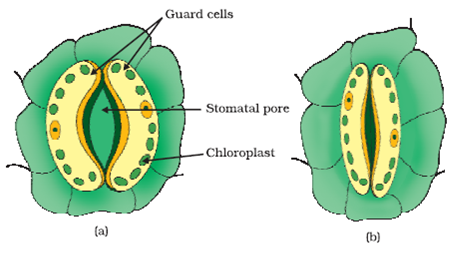
Q 7 i – Draw a well labelled diagram of stomata (2)

ii – Explain the role of the stomata in the process of photosynthesis (1)

A 7 – i Well labelled diagram of stomata is shown:


A 7 ii). Stoma in Greek means mouth. The stomata in plant are the pores in a leaf used for gas exchange. Stomata role in photosynthesis is the intake of carbon dioxide from the air and the release of oxygen and water vapour.

Q 8: Give reasons:


a – We should not measure the body temperature using laboratory thermometer.

b – Cooking pans are provided with wooden handles.

c – Climate for coastal areas remains pleasant.

A 8 – a). We should not use laboratory thermometer to measure body temperature due to following reasons:

 
 i). Laboratory thermometer does not have kink so when it is taken out of mouth there is a drop in temperature and the reading shown is incorrect.
 ii). The range of laboratory thermometer is -10 to 110 degree Celsius which is too high for measuring the human body temperature which is normally 37 degree Celsius. Also, laboratory thermometer has too many fine divisions on it, so reading the correct human body temperature will be a problem compared to clinical thermometer which doesn’t have too many fine divisions.

A 8 b: Cooking pans are provided with wooden handles because wood being an insulator or bad conductor of heat does not allow much heat to go through it. Thus the hand of the person holding the cooking pan wooden handle does not get burnt.

A 8 c). Climate for coastal areas remain pleasant due to sea breeze blowing from sea to land during day and land breeze flowing from land towards sea. There is constant circulation of heat and flow of air which keeps the weather pleasant.

Q 9: Explain any three ways to prevent rusting of iron.

A 9: Three ways to prevent rusting of iron are:

i). Painting
ii). Greasing
iii). Galvanising, i.e., doing coating of zinc

MCQ’s 

Q 10: The process of coating a layer of zinc over iron articles is called

a). Ionisation
b). galvanisation
c). Crystallisation
d). rusting

A 10: b). galvanisation

Q 11: The two symbiotic partners in lichens are:

a) Fungus and bacteria
b). Fungus and protozoa
c). Alga and fungus
d). Alga and bacteria

A 11 – c ). Alga and fungus

Wednesday, June 19, 2013

Project On Animals That Provide Us Wool


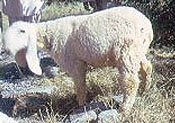
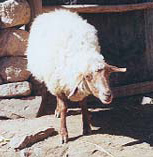
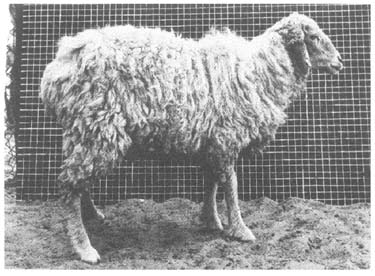
S. No.
Name of the wool yielding animal
Picture
Information – Where it is found and what kind of wool does it provide etc.
1.
Lohi Sheep
Found in Rajasthan and Punjab, India. Gives good quality of wool that is used for making woollen clothes.
2.
Rampur Bushair Sheep
Found in Uttar Pradesh, Himachal Pradesh, India. Gives brown coloured superior carpet quality wool that is used for making nice quality of carpets.
3.
Nali Sheep
Found in Rajasthan, Haryana, and Punjab, India. Gives good quality of carpet wool that is used for making premium variety of carpets.
4.
Bakharwal Sheep
Found in Jammu and Kashmir, India. The wool given by Bakharwal sheep is used for making woollen shawls.
5.
Drysdale Sheep
Found in New Zealand. Gives coarse thick wool which is used in making carpets.
6.
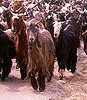
Baluchi
Found in Iran, Pakistan and Afghanistan. Gives light brown carpet wool that is coarse and is used for making carpets.
7.
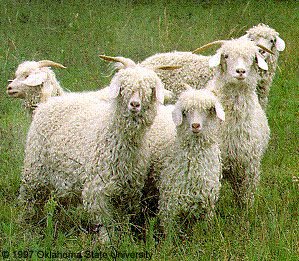
Angora goat
Found in Angora, Turkey. Produces fine quality of white or coloured wool called mohair.  Mohair is used in making carpets, scarves, winter hats, suits, sweaters, coats and socks.
8.
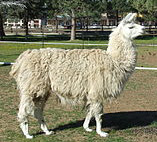
Llama camel
Found in Andes mountain region of South America. The wool of Llama camel is light weight, grease free, luxurious and soft and thus is used for great quality of woollen clothes.
9.
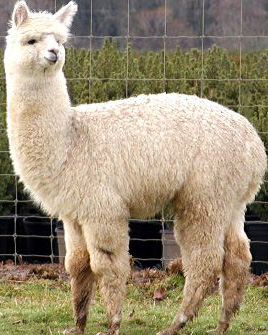
Alpaca camel
Found in Peru and other areas of South America. Alpaca camel wool is very fine and of yarn quality and so it is used for shawls, stoles and carpets.
10.
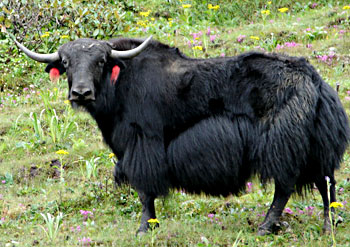
Yak
Found in Ladakh, Nepal and Sikkim in India and also in other parts of the world. The outer wool of Yak is rough whereas the inner wool is soft.  Wool from Yak is used to make blanket, socks, hats and sweaters etc.


Tuesday, June 11, 2013

Class 7 Science Answers to Summer Holiday Homework From Heat, Nutrition in Plants and Changes Of Private School - Part 1


Class 7 Science Answers to Summer Holiday Homework From Heat, Nutrition in Plants and Changes Of Private School in Dwarka, New Delhi - Part 1

The answers given here of Science class 7 holiday homework of a private school in Dwarka New Delhi are for helping children in learning and verifying that their answers are right and not for copying.

Q 1 a. Which bacterium can take atmospheric nitrogen and convert it into a soluble form?

A 1 a). Rhizobium bacteria converts atmospheric nitrogen into soluble form.

Extra: Azotobacter bacteria can also take atmospheric nitrogen and convert it into soluble form that can be used by plants.

Q 1 b. What do crops require usually to make protein?

A 1 b). Plants require nitrogen to make protein.

Q 2. Give one word/two words for the following statements:

a. The pores through which leaves take in carbon dioxide from the air.

A 2 a). Stomata

Q 2 b. A plant that has both autotrophic and heterotrophic modes of nutrition.

A 2 b). Pitcher

Extra: Venus Flytrap

Q 2 c. Movement of air from land towards ocean at night.

A 2 c). Land breeze

Q 2d . The phenomenon of increase in the atmospheric temperature due to increase of carbon dioxide concentration.

A 2 d). Global warming

Q 3. How do saprophytes help in cleaning the environment?

A 3: Saprophytes eat dead and decaying matter and thus help in keeping the environmental clean. In their absence the dead and decaying matter won’t be decomposed and converted into useful matter.

Examples of saprophyte are some fungi and some bacteria.

Q 4. Why does ship suffer a lot of damage from rusting in spite of being painted?

A 4: Ships have large surface area and are mostly in contact with salty water that strikes the painted surface with high speed (when the ship is moving fast).

Due to this the paint is worn away from the ship’s surface that is in contact with salty water.

Also in addition to water, there is availability of moisture in the air near the sea water. Thus in presence of water, oxygen and moisture ships exposed metallic part gets rusted despite of paint.

Q 5. Which would you prefer to use during winter, two thin woollen blankets or a thick woollen blanket? Give reasons for your choice.

A 5: In winter we should use two thin blankets rather than one thick blanket because two thin blankets have more layers and thus will have more air trapped in them compared to a single thick blanket. As air is a bad conductor of heat so it will prevent heat to flow from our body. More heat trapped in two blankets compared to one blanket will keep us warmer.

Q 6. Why does mercury level start falling as soon as a laboratory thermometer is taken out of a beaker containing boiling water?

A 6: The mercury level start falling as soon as a laboratory thermometer is taken out of a beaker containing boiling water because it does not have a kink or bend to stop mercury level from falling down.

Q 7. Name the elements present in the following compound.

i. Magnesium hydroxide,
ii. Calcium carbonate
iii. Sulphuric acid
iv. Sodium carbonate
v. Sodium chloride

A 7: i). The elements present in magnesium hydroxide Mg(OH)2) are magnesium, hydrogen and oxygen.

A 7 ii). The formula for calcium carbonate is CaCO3, so the elements in it are calcium (Ca), carbon (C) and oxygen (O).

A 7 iii). The formula of sulphuric acid is H2SO4. So the elements present in sulphuric acid are hydrogen (H), oxygen (O), and sulphur (S).

A 7 iv). The elements present in sodium carbonate Na2CO3 are sodium (Na), Carbon ( C ) and Oxygen (O).

A 7 v). The elements present in sodium chloride (NaCl) are sodium (Na) and Chlorine (Cl).

Q 8. How are plants and animals interdependent on each other in the forests?

A 8: Plants provide food and shelter for animals, and provide oxygen by converting carbon dioxide to oxygen through photosynthesis.

Plants also regulate the balance between carbon dioxide and oxygen for animals.

Food and Shelter: Plants are eaten by herbivorous animals, which in turn become food for the omnivorous (flesh and plant eating) and carnivorous (flesh eating) animals.

Plants are also the homes of many animals, small and big. Plants provide shelter from predators and harsh factors of the environment, like the hot sun, cold snow and heavy rains.

Plants dependant on animals: On the other hand, plants depend on animals for nutrients, pollination and seed dispersal, and as the animals consume plants, they control the numbers of different species of plants preventing from over burden of too many plants.

Animals also provide carbon dioxide to plants during exhalation. When animals die, they decompose and become manure for plants. Plants are not able to make movements, so they depend on animals to pollinate them for reproduction. And when the fertilized plants eventually produce seeds encased in fruits, animals eat them or carry them along on their fur, dispersing seeds to far and wide places ensuring the continuation of the plant species.

Q 9. Why do buffaloes enjoy a dip in a river or in a lake on a hot summer afternoon?

A 9: The black colour of the skin of buffaloes absorbs more heat in summer. The water of river or lake absorbs their body heat and helps them in lowering down their body temperature and feeling cool. So, as buffaloes feel cooler in river or lake water, they enjoy a dip in water on a hot summer afternoon.

Q 10. Classify as Physical or Chemical change:

a. Burning of Magnesium ribbon
b. Reaction between vinegar and baking soda.
c. Dipping of iron nail in copper sulphate solution
d. Stretching of rubber band

A 10 a): Burning of magnesium ribbon is a chemical change as new substance magnesium oxide is formed.

A 10 b). Reaction between vinegar and baking soda is a chemical change as new substances carbon dioxide, salt and water are formed.

A 10 c). Dipping of iron nail in copper sulphate solution is a chemical reaction as new substances ferrous sulphate and copper are formed.

A 10 d). Stretching of a rubber band is a physical change as there is temporary change in its shape and no new substances are being formed.

Sunday, May 26, 2013

Answers Of Class 7 Science Chapter 1- Nutrition In Plants


Answers Of Class 7th Science Chapter 1 – Nutrition In Plants
Question 1: Why do organisms need to take food?
Answer 1: All living organisms require food to survive. It gives them energy to perform various activities. All activities such as playing, running, walking, studying, etc. require energy. The various components present in our food such as carbohydrates, proteins, fats, vitamins, and minerals provide energy to our body. These are also important for growth and development of the body.

Question 2: Distinguish between a parasite and a saprotroph.
Answer 2:

Parasite
Saprotroph
The organism that grows on the body of another organism and derives nutrients from it is known as a parasite.
The organism that obtains nutrients from the dead or decaying organic matter is called saprotroph.
Examples of parasites are Cuscuta and orchids.
Examples of saprotrophs are fungi and some bacteria.
Question 3: How would you test the presence of starch in leaves?
Answer 3: Experiment to test the presence of starch in leaves:
Take two healthy green potted plants of the same type. Keep one potted plant in a dark room for one or two days in order to remove all the starch from the leaves. Keep the other plant in sunlight. Now, take one leaf from each potted plant and put a few drops of iodine solution on them. Then note down the observation.
Plants kept in light and dark conditions
No blue black colour will be observed on the leaves of the plant kept in the dark room. This indicates the absence of starch. Blue black colour will be observed on the leaves of the plant kept in sunlight. This indicates the presence of starch.

Question 4: Give a brief description of the process of synthesis of food in green plants.
Answer 4: Photosynthesis is defined as the process in which the chlorophyll-containing plant cells synthesise food in the form of carbohydrates, using carbon dioxide and water in the presence of solar energy.
Photosynthesis
Sources of raw materials required for photosynthesis:
(a) Water is taken in from the roots of the plant and is transported to the leaves.
(b) Carbon dioxide from the air enters the leaves through the tiny pores called stomata and diffuses to the cells containing chlorophyll.
(c) Solar energy is used to break water into hydrogen and oxygen. This hydrogen is combined with carbon dioxide to form food for the plants, which is ultimately used by the animals as well.
Thus, photosynthesis can be represented by the following equation.
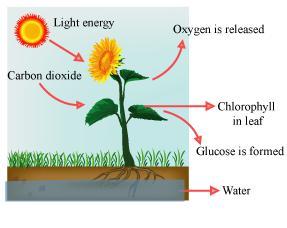
Question 5: Show with the help of a sketch that the plants are the ultimate source of food.
Answer 5:
Photosynthesis in Plants
Note: Plants are autotrophs, i.e. they make their own food. They are eaten by animals including human beings. If plants are not there herbivorous animals will not get their food and hence carnivorous animals and humans will not get food. There will be no life if plants are not there as animals are directly or indirectly dependent on plants for food.
Question 6: Fill in the blanks:
(a) Green plants are called __________ since they synthesise their own food.
(b) The food synthesised by the plants is stored as __________.
(c) In photosynthesis solar energy is captured by the pigment called ___________.
(d) During photosynthesis plants take in ___________and release ___________.

Answer 6: (a) Green plants are called autotrophs since they synthesise their own food.
(b) The food synthesised by the plants is stored as starch.
(c) In photosynthesis solar energy is captured by the pigment called chlorophyll.
(d) During photosynthesis plants take in carbon dioxide and release oxygen.
Question 7: Name the following:
(i) A parasitic plant with yellow, slender and tubular stem.
(ii) A plant that has both autotrophic and heterotrophic mode of nutrition.
(iii) The pores through which leaves exchange gases.
Answer 7:  (i) Cuscuta
(ii) Pitcher plant
(iii) Stomata
Question 8: Tick the correct answer:
(a)Amarbel is an example of
(i) autotroph
(ii) parasite
(iii) saprotroph
(iv) host
(b)The plant which traps and feeds on insects is
(i) Cuscuta
(ii) china rose
(iii) pitcher plant
(iv) rose
Answer 8: (a)Amarbel is an example of ii - parasite
 (b)The plant which traps and feeds on insects is iii – pitcher plant
Question 9: Match the items given in Column I with those in Column II:

Column I
Column II
Chlorophyll
Bacteria
Nitrogen
Heterotrophs
Amarbel
Pitcher plant
Animals
Leaf
Insects
Parasite
Answer 9: Column I
Column II
Chlorophyll
Leaf
Nitrogen
Bacteria
Amarbel
Parasite
Animals
Heterotrophs
Insects
Pitcher plant

Question 10: Mark ‘T’ if the statement is true and ‘F’ if it is false:

(i) Carbon dioxide is released during photosynthesis. (T/F)
(ii) Plants which synthesise their food themselves are called saprotrophs. (T/F)
(iii) The product of photosynthesis is not a protein. (T/F)
(iv) Solar energy is converted into chemical energy during photosynthesis. (T/F)

Answer 10:  (i) Carbon dioxide is released during photosynthesis. (F)
(ii) Plants which synthesise their food themselves are called saprotrophs. (F)
(iii) The product of photosynthesis is not a protein. (T)
(iv) Solar energy is converted into chemical energy during photosynthesis. (T)

Question 11: Choose the correct option from the following:
Which part of the plant takes in carbon dioxide from the air for photosynthesis?
(i) Root hair
(ii) Stomata
(iii) Leaf veins
(iv) Sepals
Answer 11:  (ii) Stomata
Question 12: Choose the correct option from the following:
Plants take carbon dioxide from the atmosphere mainly through their:
(i) roots
(ii) stem
(iii) flowers
(iv) leaves
Answer 12:  (iv) leaves
Full Answer: Plants take carbon dioxide from the atmosphere mainly through their leaves.